Carton printing machines are core equipment in the packaging and printing industry. They are mainly used to print text, patterns, logos and other information on the surface of carton substrates such as corrugated cardboard and cardboard, and are key process equipment before carton forming. With the diversified needs of the packaging industry, carton printing machines have formed various types. Each type, based on differences in printing principles and structural design, is suitable for different production scenarios, printing requirements and batch scales, and their uses are different. The following details the mainstream classifications and corresponding uses.
I. Flexo Carton Printing Machine (Mainstream Model for Corrugated Cartons)
Flexo carton printing machine is currently the most widely used model in the field of corrugated carton printing. Its core principle is to use elastic relief plates (resin plates or rubber plates) to transfer water-based ink through anilox rollers to achieve continuous printing. Its core characteristics are fast printing speed, high efficiency, applicability of environmentally friendly water-based ink, light printing pressure (which has little impact on the strength of corrugated cardboard), and compatibility with various corrugated cardboards (such as A/B/C/E/F flutes). It is often integrated with multiple functions such as printing, creasing, slotting, die-cutting, counting and stacking to form a linked production line.
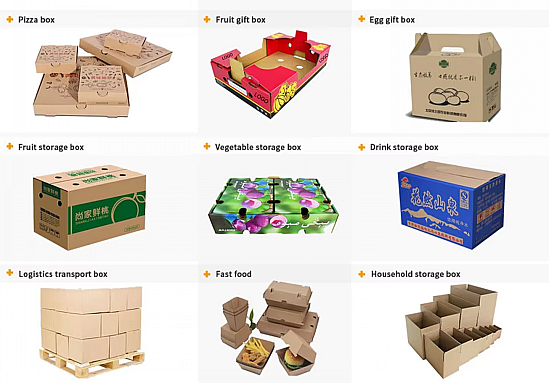
Its uses are mainly divided into two categories: first, mass printing of conventional corrugated cartons, such as express packaging cartons and ordinary commodity transportation cartons. These cartons have low requirements on printing precision, mostly monochrome or two-color text and simple logos (such as brand names, specifications, warning signs), and the high efficiency and low cost of flexo printing machines can perfectly meet these needs. Second, low-to-medium-end color carton printing, such as outer packaging cartons for ordinary food and daily necessities. It can achieve multi-color overprinting to meet basic color presentation needs without complex pattern details. In addition, according to different structures, the stacked flexo printing machine is suitable for small and medium batch production, the satellite flexo printing machine has higher overprinting precision and can be used for high-end corrugated carton printing, while the flexo printing, slotting and die-cutting machine is currently the most mainstream model, completing the core processes of carton printing and forming in one stop.
II. Offset Carton Printing Machine (Core Model for High-End Color Boxes)
Offset carton printing machine is based on the principle of ink-water incompatibility, transferring graphics and text through rubber rollers. Its core advantages are high printing precision, good color reproduction, delicate dots, which can present complex patterns, gradient effects and high-definition text, comparable to the texture of paper printing. However, its limitation is that it has high requirements on the flatness of the substrate, and is mostly suitable for cardboard. It usually needs to print the face paper first, then compound it with the corrugated core paper (i.e., pre-printing process), and cannot print directly on the corrugated cardboard with high hardness.
Its uses mainly focus on the printing of high-end and exquisite color boxes, suitable for scenarios with high requirements on printing quality and complex patterns, such as food gift boxes (pastries, health products), cosmetics packaging boxes, electronic product packaging boxes, gift boxes, etc. These cartons need to improve product grade through exquisite printing. Offset printing machines can achieve four-color and multi-color overprinting, restore photo-level pattern details, and at the same time adapt to various high-end substrates such as cardboard and laminated paper, meeting the high requirements of brands for packaging appearance. Common forms include sheet-fed offset printing machines (needing subsequent die-cutting process) and offset printing linked lines (which can complete die-cutting, gluing and other processes online). The former is suitable for small and medium batch high-end color boxes, and the latter is suitable for mass production.
III. Digital Carton Printing Machine (Specialized Model for Small-Batch Personalization)
Digital carton printing machine is an emerging model in recent years. Its core principle is to directly spray ink onto the cardboard surface through nozzles without plate making, and can realize variable data printing (such as variable barcodes, serial numbers, personalized text). Its core characteristics are fast order change, strong flexibility, no cumbersome plate making and machine adjustment processes, suitable for small-batch, multi-variety and personalized production needs. It also has high printing precision, which can present clear text and patterns. At the same time, it adopts a fully enclosed automatic ink refilling system, which is environmentally friendly and pollution-free, simple to operate, and does not require professional printing technicians.
Its uses are mainly for small-batch customized cartons, personalized packaging, sample proofing and other scenarios, such as e-commerce customized cartons (printed with customer logos and personalized greetings), small-batch outer packaging of niche brands, carton sample proofing of new products, holiday customized gift boxes, etc. These needs are characterized by small batches and many varieties. Traditional printing machines have high plate making costs and low order change efficiency, while digital printing machines can achieve “print on demand with a minimum order of one piece” and fast delivery. At the same time, they can adapt to cardboards of different thicknesses, and can achieve large-format printing at most, breaking the limit of traditional printing width. At present, the mainstream digital carton printing machines are divided into scanning type and direct output type. The scanning type is suitable for large-format small-batch production, while the direct output type is faster and suitable for small and medium-format batch production.
 Longcheng Carton Machinery